Apr 20, 2026
10 min read
A newsletter reader app is a tool designed to help you read newsletters outside your inbox, keep subscriptions organised, and create a better reading experience than traditional email.
If you have ever searched for the best newsletter reader, a newsletter reading app, or an app for reading newsletters because your inbox feels chaotic, you are already close to the problem this category solves.
As newsletters become a bigger part of how people stay informed across AI, investing, work, wellness, and culture, more readers are realising that email is a poor place to consume them. That is exactly why newsletter reader apps are starting to matter.
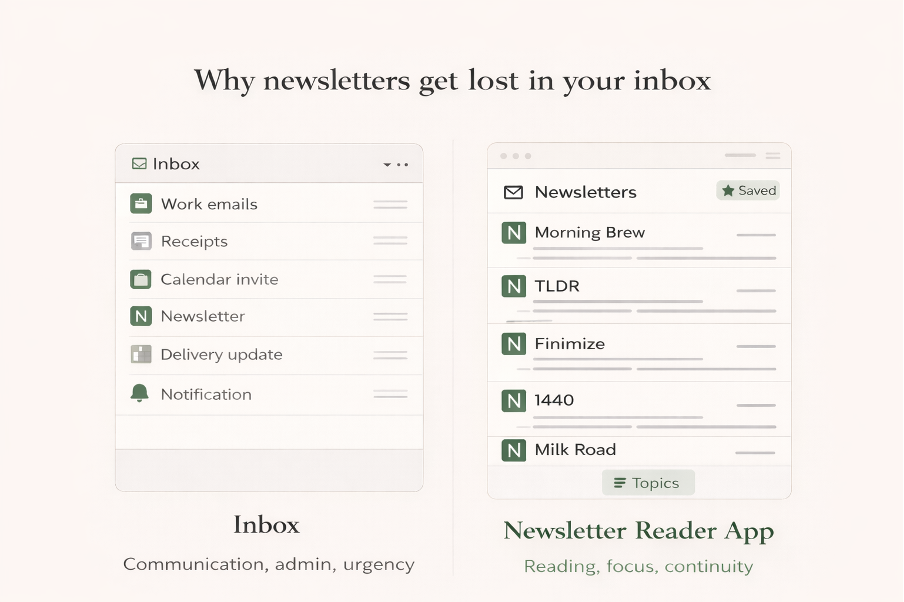
Most people do not set out looking for a newsletter reader app. They get there slowly. First, they subscribe to a few good newsletters. Then a few more. At some point, the inbox becomes a mess. The newsletters they actually want to read get buried under work emails, receipts, delivery notifications, and random admin. They still value the content, but the environment makes it harder to consume. Eventually, reading starts to feel like inbox management rather than learning.
That is the real problem. It is not that newsletters stopped being useful. It is that they are being delivered into a space that was never designed for reading.
Email inboxes are built for communication. Their logic is urgency, response, and admin. Newsletters work differently. They are closer to articles, essays, briefings, or curated reading sessions. When those two functions get forced into the same environment, the reading experience suffers.
This is why even people who genuinely like newsletters often struggle to keep up. They open one intending to read it, then get pulled into something else. A message looks urgent. A notification breaks the flow. Another tab opens. The moment disappears. By the time they come back, the newsletter feels old, irrelevant, or too long to bother with. Repeat that enough times and good content quietly turns into unread clutter.
If that sounds familiar, you do not necessarily need fewer newsletters. You may just need a better system for reading them. That is exactly the argument behind The Best Way to Manage Newsletter Subscriptions. The issue is often less about volume and more about friction.
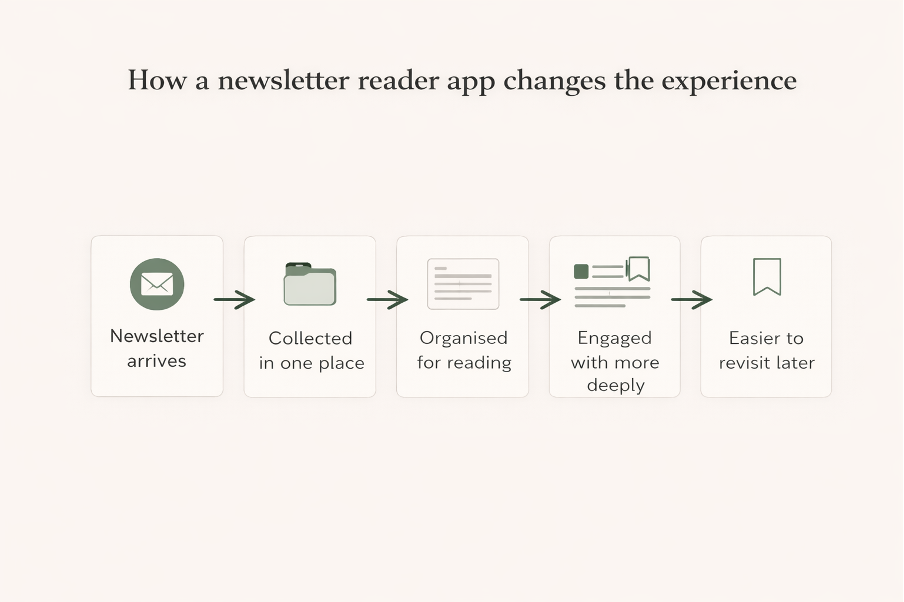
A newsletter reader app is a dedicated space where newsletters can be collected, organised, and read more intentionally than they can inside an email inbox. The point is not just storage. It is to create an environment that treats newsletters as reading material rather than as just another email.
A good newsletter reader app makes it easier to keep up with multiple subscriptions, return to interesting issues later, and separate newsletter reading from the rest of your digital clutter. In practice, that usually means cleaner interfaces, easier navigation, and features that support reading rather than communication.
That distinction matters. A normal email client is trying to do many jobs at once. A newsletter reader app is doing one job: helping you read and get more value from the newsletters you already care about.
This category did not emerge by accident. It exists because newsletters have grown into a serious part of how people learn, stay current, and make sense of fast-moving topics, while the inbox has stayed largely the same.
People are relying on newsletters for everything from startup advice to geopolitical analysis to AI updates. At the same time, many are also trying to reduce social media use, move away from doomscrolling, and build more deliberate information habits. That creates a very specific need: readers want the depth and structure of newsletters, but they do not want them lost in the same environment as work messages and admin.
That broader shift is something we have already written about in Why People Are Moving Back to Newsletters: The Fall of Algorithm Feed. The short version is simple. More people are looking for content they choose themselves, delivered in a format that respects their time and attention.
Not everyone does.
If you subscribe to one or two newsletters and read them comfortably in your inbox every time they arrive, then you probably do not need a separate tool. There is no point inventing a problem where one does not exist. Having said that, we do believe that newsletters are a great source of information, and most people could benefit from following several newsletters across various topics, rather than only one or two.
Having said that, if newsletters have already become one of your main ways of staying informed, that changes things. If you follow several writers across different topics, if your subscriptions are growing, if you keep losing good content in your inbox, or if reading newsletters has started to feel more chaotic than useful, then a dedicated reader starts to make real sense.
This is especially true for people who use newsletters as part of their work or thinking process. Founders, operators, investors, consultants, marketers, writers, and curious professionals often rely on newsletters not just for updates, but for perspective. In that context, the experience of reading matters. The more valuable the content becomes, the more obvious the limitations of the inbox become.
The first thing that matters is separation from the inbox. If a product does not meaningfully create distance between newsletters and the usual stream of communication, then it is not really solving the core issue.
The second is a clean reading experience. You should be able to open the app and feel like you are there to read, not triage email. Good design is not cosmetic here. It changes behaviour.
The third is organisation. A newsletter reader should make it easy to find what you want to read, whether that means sorting by topic, browsing archives, or returning to something later without digging through email threads.
But a really good newsletter reader should do more than organise what you already follow. It should also help you discover what is worth following next.
That part is often underestimated. Once you start relying on newsletters as a serious way to stay informed, one of the biggest challenges is not just keeping up with subscriptions, but finding high-quality writers and publishers in the first place. The newsletter ecosystem is now vast, fragmented, and hard to navigate well.
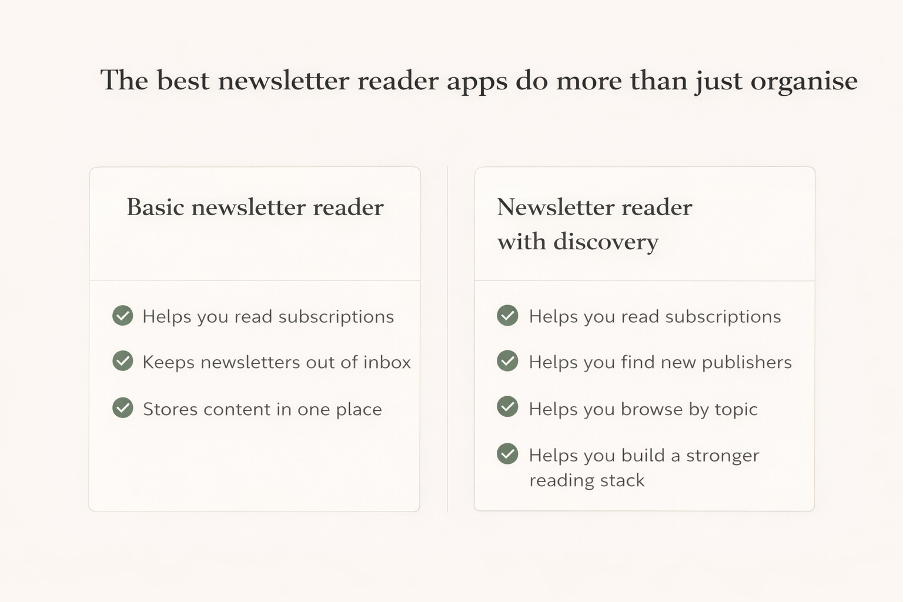
A product that only helps you read what you already know about solves one part of the problem. A product that also helps you uncover better sources solves a much bigger one.
That is why discovery should be treated as a core feature, not a bonus. The best newsletter reader apps should help users explore new publishers, browse by topic, and build a stronger reading stack over time. In practice, that means the product becomes useful not just as a reading tool, but as an information discovery layer as well.
Then there are the features that make the experience more useful over time. Highlights matter because they help you engage with what you are reading instead of skimming passively. Notes matter because good reading often produces thoughts worth keeping. Summaries can be useful when you are short on time. But discovery is what makes the whole system expand in value, because it helps users not only read better, but find better things to read in the first place.
Bilig is a dedicated newsletter reading platform designed to give newsletters their own space away from inbox clutter.
Instead of forcing valuable content to compete with the rest of your email, it creates a cleaner environment built specifically for reading. You can organise your subscriptions, explore 600+ newsletters, highlight interesting parts, take notes, save pieces for later, and use AI-powered summaries when you want the main ideas quickly.
What makes that useful is not just convenience. It is the shift in mindset that comes with it. When newsletters live in a dedicated reading environment, they stop feeling like email admin and start feeling like what they actually are: a recurring source of insight, learning, and perspective.
That is also why Bilig has spent time writing about the broader context around newsletter reading, not just the product itself.
If your bigger problem is attention, Ditch Doomscrolling: How Newsletters Beat Social Media for Your Brain is a helpful companion. If you are still figuring out how to build a better reading system, How to Build a Quality Newsletter Stack (and Stop Information Overload) is another useful next step.
A newsletter reader app is not something everyone needs. But for the growing number of people who rely on newsletters to stay informed, it is becoming a very sensible tool.
The inbox is good at many things. Reading is not one of them.
So if newsletters keep getting buried, if good issues are going unread, or if you find yourself thinking there should be a better way to keep up with the content you actually value, you are probably not imagining it. You are simply running into the limits of the wrong interface.
That is where a newsletter reader app earns its place. Not by making reading louder or faster, but by making it easier to do properly.