Apr 8, 2026
14 min read
Something quietly shifted in how people consume information online. It did not happen with an announcement. It happened gradually, in the private frustration of millions of users who opened their social media feeds and realised, somewhere between the rage bait and the sponsored content, that what they were looking at had almost nothing to do with why they had originally signed up.
Social media was supposed to connect us. It was supposed to be a window into the lives of people we know, a place to share ideas, a way to stay close to friends and communities spread across the world. For a brief period, it was all of those things. Then the algorithm arrived, and slowly, deliberately, it began to optimise for something else entirely.
Today, the average person spends over six years of their life on social media. What they encounter there is increasingly not a reflection of their social world, but a curated performance designed to extract as much attention as possible. According to Meta, 50% of feed content is now surfaced by AI recommendations (Intellibright), often with no connection to the accounts people actually chose to follow. The feed is no longer yours. It belongs to the algorithm, and the algorithm has different priorities to you.
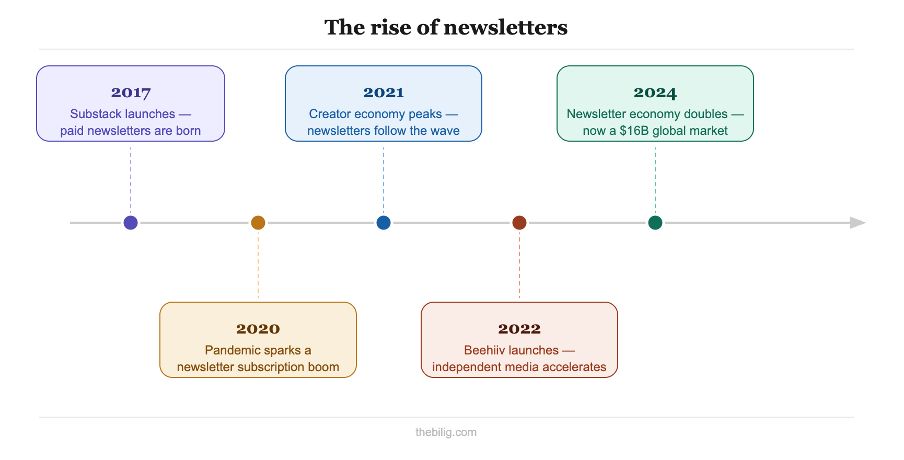
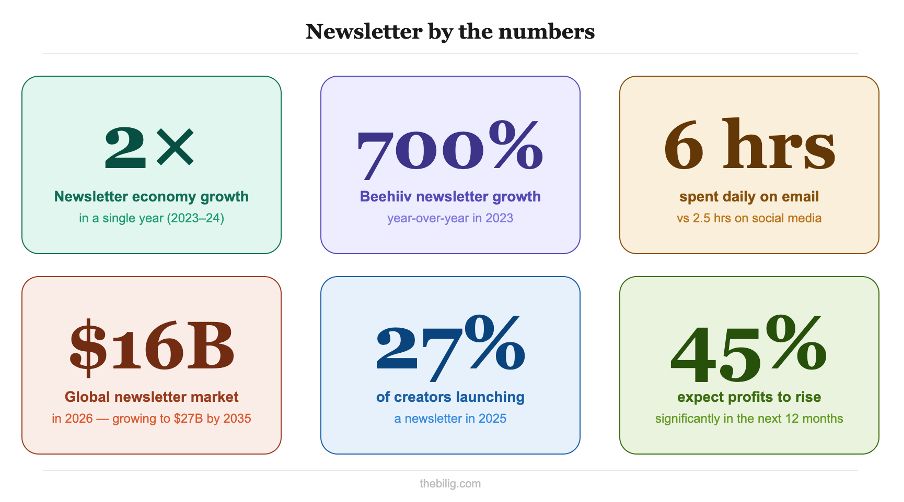
Against that backdrop, something significant is happening. The newsletter economy nearly doubled between 2023 and 2024, growing from 26,911 to 52,809 newsletters (Mailmend). On the Beehiiv platform alone, there was a 700% increase in newsletters year-over-year in 2023 (Whop). According to HubSpot's 2025 State of Newsletters report, 27% of creators planned to start a newsletter in 2025, with the key reasons being owning more of their channels and building deeper connections with their audiences (HubSpot). People are not just subscribing to newsletters. They are creating them, funding them, and building reading habits around them. That is not a coincidence. It is a response.
This piece is about why that shift is happening, what it tells us about where social media went wrong, and why newsletters — for all their simplicity — are meeting a need that the most sophisticated algorithmic platforms in history have failed to satisfy.
Bilig is a newsletter reading platform built to make that shift easier. If you want to understand how to replace low-value scrolling with intentional reading, Beat Brain Rot: 10 Ways to Replace Doomscrolling and Reclaim Your Attention is a practical starting point. For a deeper look at how newsletters compare to the social feed as an information source, Ditch Doomscrolling: How Newsletters Beat Social Media for Your Brain covers the evidence. And if you want to build a reading stack worth keeping, How to Build a Quality Newsletter Stack gives you a framework.
The name has become a kind of historical artefact. Social media, in the original sense of the phrase, implied something human: people sharing things with other people. Your friends' photos. Your cousin's holiday. A conversation between people who chose to follow each other because they actually had something in common.
That version of social media still exists, technically. But it has been progressively buried. In mid-2022, Facebook started prioritising creator posts and public content in the main feed to compete with TikTok, even if it meant showing fewer friend updates. Instagram followed a similar trajectory, with its algorithm pushing Reels and recommended content from accounts users had never interacted with. TikTok built its entire model on this premise from the beginning: the For You Page is not a social feed at all. It is a behaviour-prediction engine that surfaces content from strangers based purely on what will keep you watching.
The result is that the feed, across almost every major platform, is now dominated by professional content creators, media organisations, brands, and sponsored posts, all competing for your attention using tactics refined by years of algorithmic optimisation. What those tactics tend to have in common is that they prioritise emotional reaction over genuine value. Algorithms boost emotionally charged posts, especially negative or sensational ones, encouraging doomscrolling: compulsive scrolling through bad news, which worsens anxiety and depression.
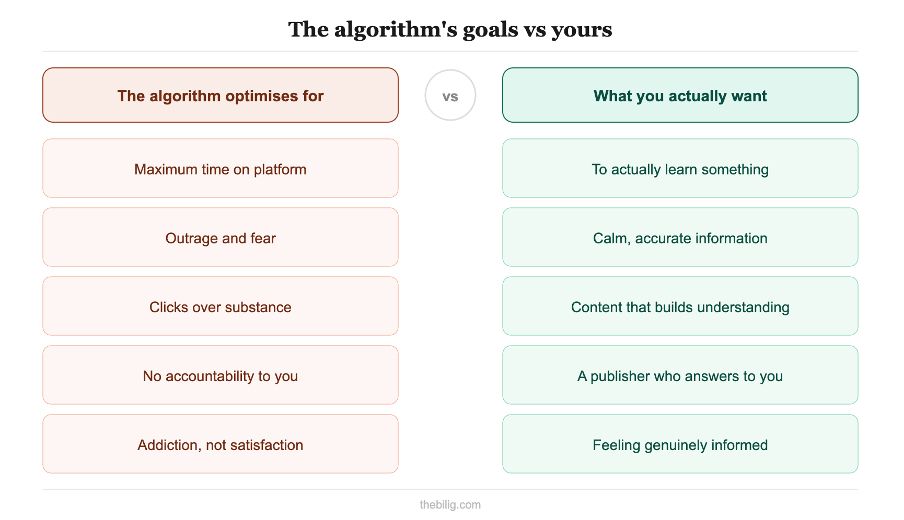
This is not an accident. It is the logical outcome of building platforms optimised for engagement rather than for the quality of user experience. Outrage, fear, and tribalism generate more clicks than nuance, context, and calm. The algorithm does not know the difference between content that informs you and content that simply agitates you. It knows what you clicked on.
What has been lost in this process is accountability. On a social feed, content is surfaced by an opaque machine. No one is responsible for what you see. The algorithm is not answerable to you. The creator of a viral piece of rage bait has no obligation to you as a reader. The platform profits regardless of whether you finish the session feeling better or worse informed than when you started. The relationship is entirely extractive, and most users, even if they could not articulate it precisely, have started to feel that.
The commercial incentives of social media are worth examining not just in terms of what they show us, but in terms of what they have done to us.
Research published in 2025 found that frequent engagement with social media platforms alters dopamine pathways, fostering dependency analogous to substance addiction. Changes in brain activity within the prefrontal cortex and amygdala suggest increased emotional sensitivity and compromised decision-making abilities (PubMed Central).
A 2025 study found that excessive use of AI and social media can cause lower recall and retention, reduced brain function, and memory loss. A review of 71 studies published by the American Psychological Association found that excessive short-form video consumption is directly associated with diminished cognitive functions (National Geographic).
The implications of this are not just personal. They are practical. The same populations who have grown up on algorithmically-curated short-form content are now finding long-form reading genuinely difficult. The habit of sustained attention — the kind required to follow an argument across several paragraphs, to sit with a complex idea, to read something that does not immediately grab you — has been eroded by years of content designed to compete for every second of your attention in a feed where the next thing is always one swipe away.
This is one of the real challenges facing newsletters as they grow in prominence. The product is excellent. The audience's capacity for it has been partially damaged by the very platforms they are trying to leave behind. The honest acknowledgment of that tension is part of what makes the newsletter resurgence more interesting than a simple case of one medium displacing another. It is a counter-movement, and like all counter-movements, it requires some effort from the people participating in it.
Despite that headwind, the numbers tell a clear story. People are subscribing, reading, and paying for newsletters in volumes that would have seemed improbable a decade ago.
Email users spent close to six hours a day on email compared to just 2.5 hours on social media in 2023 (Whop). That gap is striking given how much cultural conversation focuses on social media dominance. In 2024, newsletter operators saw significant revenue increases, with paid subscriptions, ad networks, and reader-support tools all generating substantially more income than in previous years (Beehiiv Blog). One quarter of newsletter creators experienced substantial profit growth in the past year, and 45% expected their profits to increase significantly over the following 12 months (HubSpot).
The reasons behind these numbers are not complicated. Newsletters offer something the algorithm cannot replicate: a direct relationship between a writer and a reader, with no intermediary deciding whether the content gets seen, no feed to compete with, and no engagement optimisation distorting what gets published. When you subscribe to a newsletter, you are making a deliberate choice. You have decided that this person or publication is worth your inbox. That act of intention changes the relationship entirely.
Beehiiv's Head of Brand Partnerships noted in 2024 that high-value consumers had increasingly begun curating their own news and content consumption, signalling a broader shift in engagement patterns. That phrase, curating their own consumption, is the key one. What is driving the newsletter resurgence is not just dissatisfaction with social media. It is a growing desire for agency. People want to decide what they read, not have it decided for them by a system whose interests are not aligned with theirs.
There is also the question of accountability. A newsletter writer has their name on it. They have a relationship with their subscribers that depends on continued trust. The format creates a structural incentive toward quality and honesty that algorithmic feeds do not, and arguably cannot, replicate. That accountability is part of what makes newsletters feel different. They feel like something a person made, for people, rather than something a machine surfaced because the data said it would generate a reaction.
The newsletter resurgence is real, and its momentum appears durable. But it would be naive to declare the algorithm feed dead. The platforms are enormous, deeply embedded in daily routines, and continuing to evolve.
Audiences have shifted from casual scrolling to more intentional engagement, and platforms are adapting. Visibility is no longer enough, and people want relevance, authenticity, and content that respects their time. The commercial incentive to improve the feed experience, if only to prevent further erosion, is significant.
The friction of switching matters too. Newsletters require a level of engagement that social media has spent years training people out of. Reading a 1000-word newsletter requires focus. It requires sitting with something for a few minutes rather than consuming it in seconds and moving on. For readers whose attention has been shortened by years of algorithmic feeds, that ask is not trivial.
The counter-movement toward newsletters is also, in part, a project of attention rehabilitation. Reading more is partly about finding better content. It is also about rebuilding a capacity that has been quietly diminished.
That is why the growth of newsletters is most meaningful not just as a content trend but as a cultural one. The people choosing newsletters are, consciously or not, choosing a different relationship with information — one that involves more intention, more friction, and ultimately more reward. They are opting out of the passive extraction model and into something that requires and returns more from both sides of the relationship.
The global newsletters market is estimated at over $16 billion in 2026, with projections placing it at $27 billion by 2035 (Business Research Insights). The tailwinds are structural. As third-party cookies continue to phase out, as trust in social platforms continues to erode, and as a generation of readers begins to actively seek out alternatives to the feeds that shaped their early digital lives, newsletters are well positioned to continue their rise.
The algorithm feed is not dead. But its dominance is no longer uncontested, and the contest is more interesting than it has ever been.
If you want to build a reading habit that replaces low-value scrolling with content that actually informs and compounds over time, Bilig is designed to make that easier. It gives your newsletters a clean, focused home away from the noise of a cluttered inbox. You can explore Bilig's features or start discovering newsletters on the newsletter directory.
The shift back to newsletters is not about nostalgia for a simpler internet. It is about something more fundamental: the desire to read content made by people who are accountable to you, delivered through a channel you control, on your terms. That is a quiet revolution. But it is a real one.