Apr 15, 2026
10 min read
Digital minimalism is the practice of being deliberate about which technologies you allow into your life. And newsletters are one of the few digital habits that actually holds up to that scrutiny. If you have been trying to reduce your time on social media while staying genuinely informed, newsletters provide you with arguably the best option to stay informed while cleaning all the 'dirt' from your digital life.
This post applies Cal Newport's digital minimalism framework to how you consume information and makes the case that the right newsletter reading practice does something the algorithm feed never could: it makes you more informed while demanding less of your attention.
Newport's argument in Digital Minimalism is not that technology is bad. It is that most people have adopted digital tools without ever deciding whether those tools serve their actual goals. The result is a life shaped by platform defaults, including infinite scroll, push notifications and algorithmic feeds, rather than by deliberate choice.
The fix is not to delete everything. It is to be ruthlessly selective about what stays, and to use what stays in a way you control.
Most people apply this to social media, screen time, and notifications. Very few apply it to how they consume written information. That is the gap this post is about.
The obvious move when you are trying to reduce your digital consumption is to cut news and information entirely. In today's environment, that is not practical — neither socially nor professionally. Most people have jobs that require them to be on top of what is happening in their industry. And socially, you don't want to be 'that person' who is completely oblivious to what is happening in the world.
The real challenge, therefore, is not reducing consumption. It is raising the quality of what you consume while lowering the time it demands.
That distinction is important. Spending 90 minutes a day scrolling a news feed is not the same as spending 30 minutes reading three newsletters you chose yourself. The second is not just more efficient, but it is a different cognitive experience entirely. The research on this is clear: deep reading improves comprehension, retention, and focus in ways that passive scrolling does not.
Newport proposes a useful question for evaluating any technology: does this tool substantially support something you deeply value, and is it the best way to do so?
Run newsletters through that test and they hold up surprisingly well.
You are in control. You choose who you follow. No algorithm decides what appears in your reading list based on what will keep you on the platform longest. The writers you follow earn their place by being consistently worth reading.
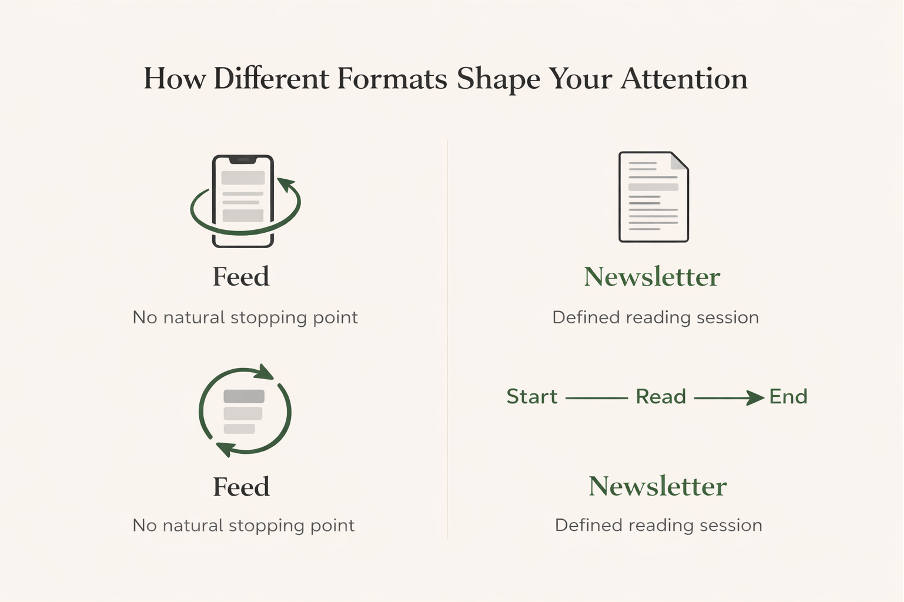
There is a beginning and an end. A newsletter issue has a finite length. You read it, and you are done. There is no equivalent of the infinite scroll, which is the design feature that Newport specifically identifies as an attention trap. This is not a small thing. It is the structural difference between a tool that serves you and one that captures you.
The incentive model is different. Most newsletters earn money through subscriptions or through carefully selected sponsorships. That means the writer's incentive is to produce something worth reading, not something that maximises your time on the platform. This is why newsletter readers trust their writers at nearly twice the rate that social media users trust their feeds.
You are building something. Reading a thoughtful newsletter on a topic you care about consistently, over months, builds genuine knowledge. Scrolling a feed does not. The information evaporates. Good newsletters compound.
Newport recommends starting with a clean slate. First remove everything, then only add back what genuinely serves you. Applied to newsletters, that looks like this:
Before you subscribe to anything, write down the three to five domains where staying informed actually serves your life or work. For most people this is narrower than they expect. You probably do not need to be current on everything — just a few things, deeply.
Not five. One. The constraint forces you to choose the best source rather than hedging. If you are not sure which to pick, our guides to newsletters by topic are a good starting point. We have covered geopolitics, finance, technology, health, career, and culture.
This is the step most people skip, and it is the reason most newsletter reading practices fail. Your email inbox is not a reading environment. It is a communication environment, and everything inside it competes for the same attention. When your newsletters land next to meeting requests and receipts, they lose. Moving newsletters to a dedicated reading space is not optional. It is the practical precondition for everything else working.
Newport is insistent on this point: you control when technology gets your attention, not the other way around. That means reading your newsletters at a set time rather than whenever a notification arrives. A thirty-minute reading session three times a week is more valuable than checking newsletters reactively throughout the day. Pick the slot that works for you.
Every few months, go through your subscriptions and remove anything you have been skimming or skipping. A list that was right six months ago may not be right now. The goal is a small number of sources you genuinely look forward to, not a comprehensive archive you feel vaguely guilty about.
Here is the practical problem: even if you subscribe to the right newsletters, read them intentionally, and keep your list short, the inbox works against all of it. Newsletters buried in Gmail sit alongside everything else demanding your attention. They get opened reactively, skimmed, and forgotten.
Your email inbox was simply not built for newsletters. Its primary purpose was communication, not reading high-quality content. Expecting it to serve as a reading environment is like expecting your work desk to be a good place to meditate.
Bilig exists to solve this. It gives newsletters a dedicated space separate from your inbox, organised by topic, with a clean reading interface that has no competing notifications, no algorithmic feed, and no infinite scroll. You can discover new newsletters across the topics you care about, read them at your own pace, highlight what matters, and track what you have read.
It is, in Newport's terms, a tool that substantially supports something you deeply value — staying genuinely informed — without the attention costs that come with every other way of doing it.
Digital minimalism is essentially about reading what matters instead of reading less for the sake of it. Newsletters, the right ones, read intentionally, kept out of your inbox, are one of the few digital habits that gets more valuable the more deliberately you approach them.
If you are already thinking about how to be more intentional about your information diet, newsletters are where to start. And if you want a reading environment that supports that intention rather than undermining it, that is what Bilig is for.